 Lisa Boerger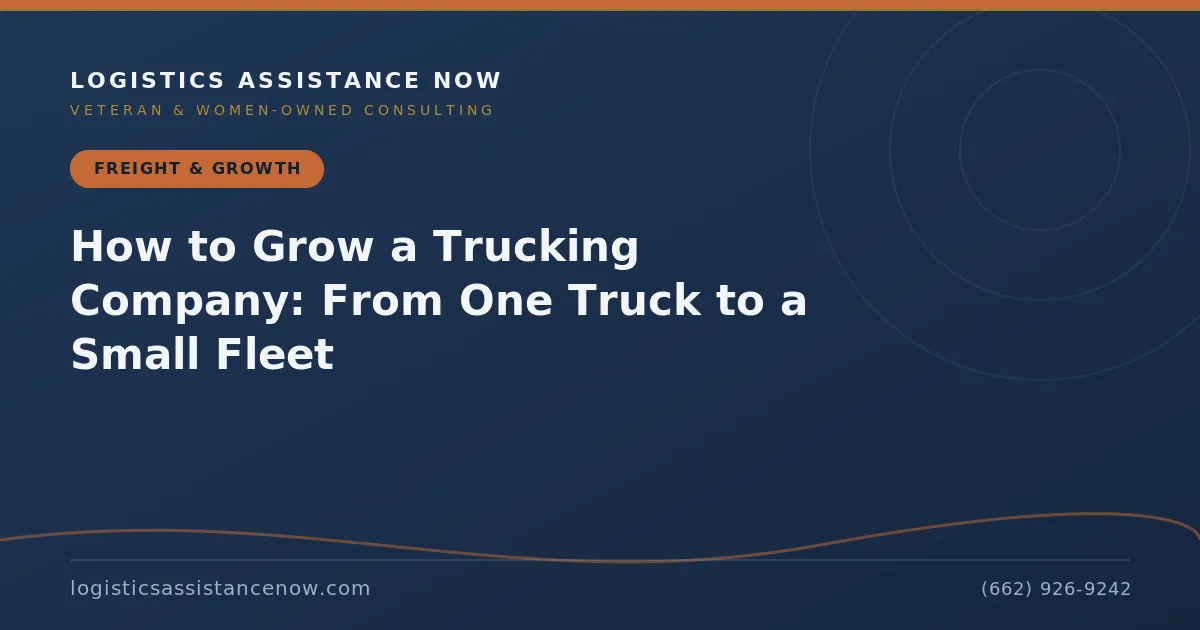
Adding a second truck feels like the natural next step once your one-truck operation is running well. The logic is intuitive: if one truck makes money, two trucks make more money. What happens next is where a lot of owner-operators get into trouble.
The jump from one truck to a small fleet is one of the highest-failure transitions in this industry. Not because the operators who attempt it are bad at trucking — most of them are excellent drivers with solid operational instincts. They fail because the business they are scaling into is a fundamentally different business than the one they are scaling from. And they often do not find that out until the money runs out.
This post lays out what the transition actually requires: the financial reserves, the operating systems, the compliance obligations, and the shift in your own role that has to happen before growth becomes sustainable.
The Most Common Premature-Growth Mistake
Here is my opinion, directly stated: the most common reason owner-operators fail when scaling is that they mistake consistent revenue for a scalable system.
Running one truck profitably means you are good at logistics, good at managing your own time and equipment, and have freight relationships that work for your capacity. None of that automatically extends to a second truck. When you add a truck, you are adding a driver, an additional equipment liability, a second insurance premium, additional compliance complexity, and a variable you cannot fully control — which is another person’s performance and decision-making.
I have seen operators whose first truck ran beautifully go into financial distress within six months of adding a second, because the systems and reserves were not there to absorb the additional volatility. They were not undercapitalized for the truck. They were undercapitalized for everything that goes wrong with the truck.
Are You Actually Ready? The Readiness Checklist
Before you sign for a second piece of equipment, work through these questions honestly.
Financial readiness:
- Do you have at least three to six months of fixed operating costs for both trucks in accessible cash reserves? Not in projected earnings — in the bank.
- Is your first truck profitable enough that it can continue covering its own costs if the second truck has an off month?
- Do you have a working capital line of credit, or the ability to access one, for unexpected expenses?
- Are your current accounts receivable under control? Slow-paying customers become a crisis when you have doubled your overhead.
Freight readiness:
- Do you have enough committed or semi-committed freight to fill a second truck, or are you planning to find it after the truck is on the road?
- Are your current shipper or broker relationships strong enough to expand capacity with them, or do you need to develop new business first?
- Have you talked to your existing freight contacts about your expansion plans and gauged their interest?
Systems readiness:
- Do you have a dispatching process documented, or does all of it currently live in your head?
- Do you have a consistent maintenance tracking system and a preferred shop or mobile mechanic relationship?
- Do you have a driver qualification and onboarding process, or will you be figuring that out when you hire someone?
If most of these answers are “not yet,” that is not a stop sign. It is a sequencing signal. Get those things in order first.
Cash Reserves: The Number That Matters Most
There is no universal cash reserve number that works for every operation, but there is a framework. Before adding a truck, you want to be able to absorb:
- One month of dead time on the new truck while you on-board a driver and establish freight
- A major repair on either truck — engine, transmission, axle — without it being an emergency
- A slow-pay or non-pay freight situation without missing your own obligations
- The time between when your driver’s first settlements generate and when your expenses are due
What that looks like in practice depends on your truck’s cost structure, your insurance costs, and your freight margins. Calculate your all-in monthly cost per truck, multiply by three at minimum, and that is your floor before you expand.
This is one of the most important and most skipped steps in small fleet growth. Our business consulting services for trucking companies include helping operators build and stress-test their financial models before making equipment decisions.
Hiring vs. Leasing: Knowing the Difference and the Risk
When you add a truck, you need someone to drive it. The two primary models — hiring a W-2 employee driver or bringing on an independent contractor (IC) — have fundamentally different legal, financial, and operational implications.
W-2 employee drivers require payroll processing, employer tax contributions, workers’ compensation coverage, and compliance with applicable labor law. They give you more direct control over scheduling, routes, and work standards. The compliance burden is higher, but the relationship is legally cleaner in most jurisdictions.
Independent contractors operate their own businesses and are responsible for their own taxes, insurance (beyond what may be required under your operating authority), and expenses. However, IC classification is one of the most legally scrutinized areas in trucking. The IRS, the Department of Labor, and individual states all have their own tests for whether a worker is truly independent or is functionally an employee. Misclassification — whether intentional or not — can result in significant back taxes, penalties, and legal liability.
This is not an area to handle casually based on what other small carriers are doing. The rules vary by federal standard, state law, and freight category. Before you classify anyone as an IC, get qualified guidance on whether that classification holds up under current applicable tests.
We work with carriers on IC compliance and driver program structure — this is an area where an hour of proper guidance is worth months of potential headache.
The Compliance and Insurance Step-Up
Adding trucks to your authority is not just a paperwork exercise. It triggers real changes in your compliance profile and insurance obligations.
Insurance: Each additional power unit typically needs to be listed on your policy. Your premiums will increase. More importantly, if you are adding a driver who is not you, that driver’s MVR (motor vehicle record), CDL status, and experience level will affect your insurability and your rates. Know this before you commit to a hire.
DOT compliance: The number of trucks you operate does not change your fundamental FMCSA obligations, but the complexity of managing them scales. Driver qualification files, hours of service records, drug and alcohol testing program (you need a proper consortium if you are not already in one), and vehicle inspection records — all of these need to be actively managed for every driver and every vehicle. What you could keep in your head for one truck will not hold for two or three.
UCR and apportioned registration: Additional vehicles mean additional fees and registrations. This is manageable, but budget for it.
If your current compliance processes are informal — and for many single-truck operators they are — scaling is the time to formalize them. A compliance gap that costs you an out-of-service on your first truck is a problem. The same gap affecting two trucks with two drivers is a bigger problem proportionally, and a worse one at audit.
The Role Shift: From Driver to Manager
This is the piece that surprises people most, and the one that matters most.
When you run one truck, you are the driver. Your judgment, your feel for the road, your relationships with dispatchers and dock workers — that is the product. You control it directly.
When you run two trucks, you are the manager of one of those trucks. Your judgment now has to operate through another person. Their performance, their professionalism, their decisions about hours, maintenance, and customer interaction are your business’s performance. And they are not you.
The transition from driver to manager requires:
- Clear expectations communicated in writing (a driver handbook does not have to be elaborate, but it does have to exist)
- A process for addressing performance issues quickly and fairly
- Letting go of the idea that anything done differently than how you would do it is done wrong
- Systems for monitoring performance without micromanaging — ELD data, on-time delivery records, fuel efficiency by driver
Many owner-operators who are outstanding drivers become poor managers not because they lack leadership ability but because they never built the tools. Management is a skill set you can develop, but you have to treat it as one.
Build the Business First, Then the Fleet
The operators who scale successfully almost always do it the same way: they build the business infrastructure — the freight relationships, the financial cushion, the processes, the compliance foundation — before they add equipment. The truck is the last piece, not the first.
Sequence matters enormously here. If you are thinking about growth and want to build a realistic roadmap for when and how to add capacity, that is exactly the kind of planning work we do. Learn more about how LAN supports growing trucking businesses.
Frequently Asked Questions
Q: How do I know when I have enough freight to justify a second truck? A reasonable benchmark is when you consistently have more freight opportunities available than your current truck can cover, and those opportunities are from relationships reliable enough that you would stake a monthly equipment payment on them. Spot load board volume does not count — that is market noise. Committed or semi-committed lanes from real relationships are what you want to see.
Q: Should I buy or finance the second truck? Both have merits depending on your cash position and credit profile. Financing preserves cash for operational reserves, which matters a great deal in the early months of expansion. A purchase eliminates the payment obligation but can deplete the reserves you need to weather surprises. Run both scenarios against your actual cash position.
Q: What systems do I need in place before I add a driver? At minimum: a driver qualification file process, a drug and alcohol testing consortium enrollment, a vehicle inspection and maintenance log, a basic driver agreement or handbook, and a payroll or settlement process depending on whether you are hiring a W-2 employee or working with an IC.
Q: Does adding a truck change my FMCSA filing requirements? Your basic operating authority does not change, but you should notify your insurance carrier and update your UCR registration for the additional unit. If you are adding a driver for the first time, you may also need to set up or verify your drug and alcohol testing program. Consult a compliance advisor about your specific situation.
Q: Can LAN help me build a growth plan for my trucking business? Yes. We work with owner-operators and small carriers at exactly this stage — helping you build the financial model, evaluate the freight, structure the compliance, and plan the hiring before you make commitments. Schedule your free consultation here.
Ready to Grow the Right Way?
If you are thinking about adding a second truck and want to build a plan that actually holds up, LAN can help. We work with owner-operators and small fleets across the country — and right here in the Memphis metro area — to make sure growth decisions are built on solid ground.
Book your free consultation at logisticsassistancenow.com/contact
Disclaimer: This post reflects general operational and business guidance. Worker classification, insurance requirements, and FMCSA compliance rules vary by situation, jurisdiction, and federal guidance. Verify current regulations with a qualified compliance advisor and consult an attorney before making worker classification decisions.